Ask three embroidery digitizing services for a price and you might hear three different answers in three different units.
Ask three embroidery digitizing services for a price and you might hear three different answers in three different units. One says “$1.50 per thousand.” Another says “$10 flat for a left chest.” A third says “send the art and we’ll quote it.” None of them is lying. They are just measuring the same job with different rulers.
The most common ruler in machine embroidery is the stitch. This guide explains how embroidery digitizing price per 1,000 stitches actually works, how to run the math yourself, what a 10,000 or 20,000 stitch design really costs, and why the stitch count on your invoice is only half the story.
Price per 1,000 Stitches in 2026
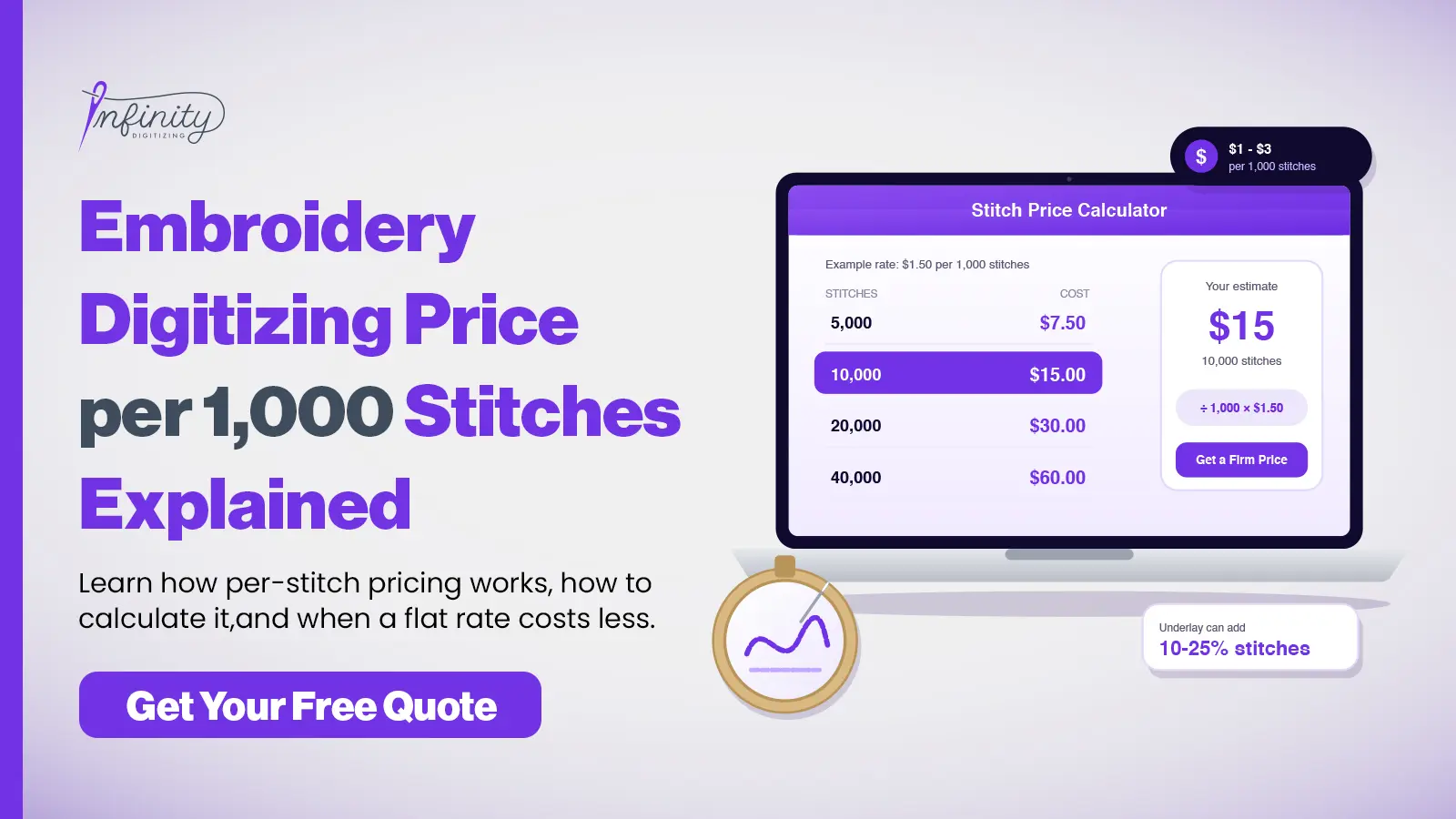
Digitizers that bill by stitch count multiply the finished file’s stitches, in thousands, by a set rate. Publicly listed US-market rates in 2026 commonly fall between $1 and $3 per 1,000 stitches, usually with a minimum charge for small designs and sometimes a maximum cap for very large ones.
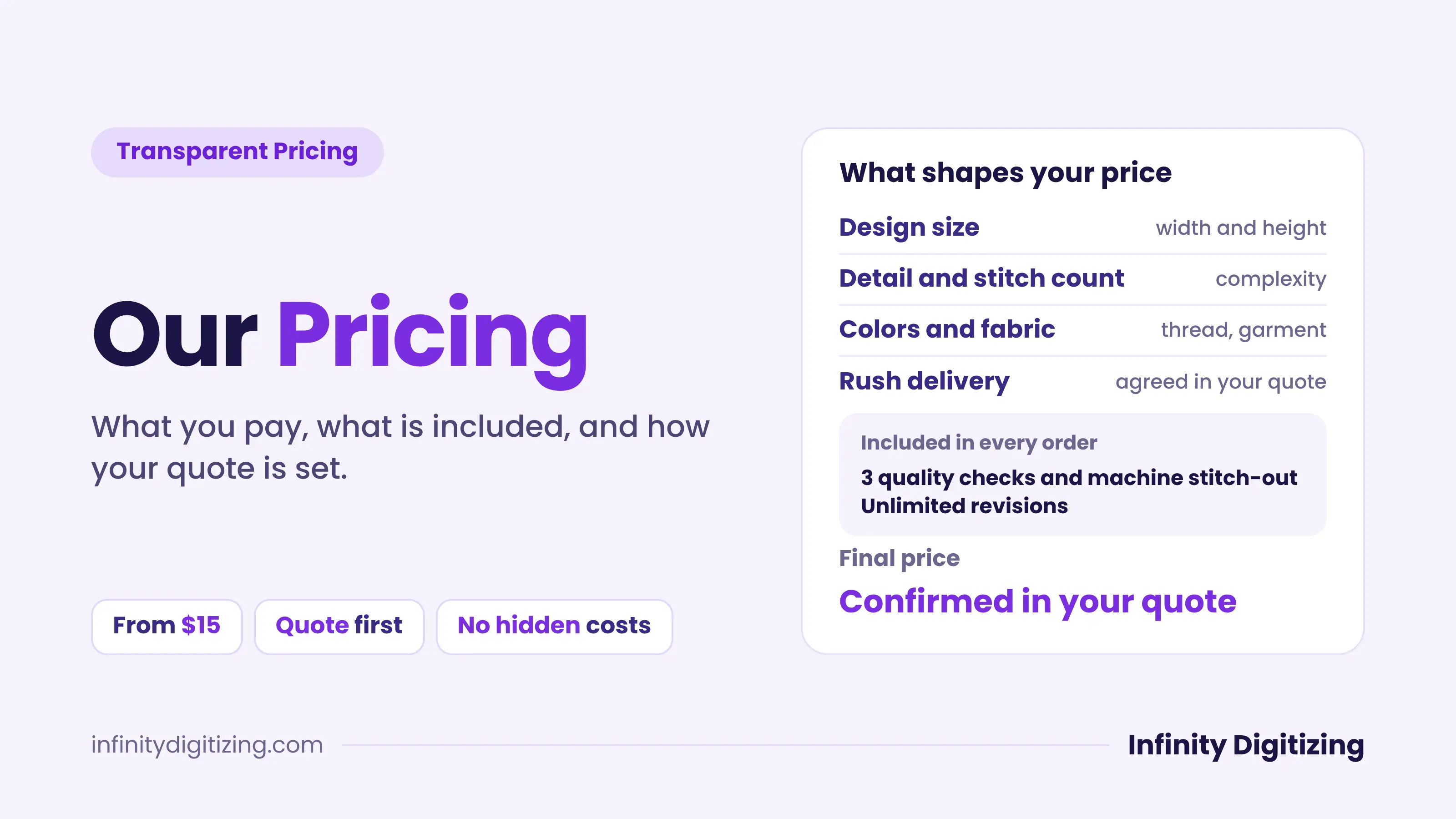
Infinity Digitizing takes a different approach. Instead of billing per stitch, it prices each design by size and complexity, starting at $15, so you know the total before the file is built. Both models are explained below so you can compare any quote on equal terms.
What Is Per-1,000-Stitch Pricing?
Per-1,000-stitch pricing charges you for the size of the finished embroidery file, measured in stitches. Every embroidery design is a list of needle penetrations. A small monogram might have 2,000 of them. A full jacket back can have 60,000 or more. The embroidery digitizer builds the file, the software reports the total stitch count, and the bill follows that number.
It became the industry standard for a simple reason: stitch count is easy to measure and roughly tracks how big and filled a design is. More stitches usually mean more coverage, more machine time, and more thread.
Where the stitches come from
Stitches are not spread evenly. They come from three basic stitch types, and each one “costs” a different amount of the count:
• Running stitch. A single line of stitches used for outlines, fine detail, and travel paths. Very low stitch count.
• Satin stitch. Tight zigzag columns used for lettering, borders, and narrow shapes. Moderate count, high shine.
• Fill stitch (also called tatami). Rows of stitches that cover large areas. This is where stitch counts climb fastest.
On top of the visible stitches, every professional file also contains underlay, a foundation layer sewn first to stabilize the fabric. Underlay can add 10 to 25 percent to a design’s total stitch count, and it is one of the reasons two files of the same logo can show very different numbers.
Is embroidery digitizing charged by stitch count everywhere?
No. Per-stitch billing is common, but plenty of embroidery digitizing services now use flat rates by size, by placement, or by complexity. That shift happened because customers wanted to know the price before the work, not after it. Stitch count still matters in every model, though. It just shows up in different places.
What Is the Average Price per 1,000 Stitches?
Across publicly listed embroidery digitizing rates for the US market in 2026, the per-thousand price usually sits between $1 and $3. Where a company lands in that band depends less on the rate itself and more on what is bundled around it.
Rate band per 1,000 stitches | What it usually comes with |
Around $1 | A minimum charge, often in the single digits to low teens. Basic edits. Volume-focused service. |
$1.50 to $2 | Minimum charge plus small extras such as free cap conversion or minor size changes. |
Up to $3 | More hands-on work, specialty effects, or faster turnaround built into the rate. |
The three numbers that matter more than the rate
A headline rate means little on its own. To compare embroidery digitizing rates properly, look for these three numbers in the fine print:
1. The minimum charge. Small designs rarely hit the rate at all. If the minimum is $15, a 4,000-stitch name tape costs $15, not $4.
2. The maximum cap. Some services stop counting after a certain point. Without a cap, a dense jacket back gets very expensive very fast.
3. Add-on fees. Text changes, rush delivery, resizing beyond a small range, and real sew-out photos are sometimes billed separately.
Some companies also use a cascading structure, where the per-thousand rate drops as the stitch count rises. That rewards big designs but makes the final number harder to predict.
Bottom line: the “average” embroidery digitizing cost per 1,000 stitches is less useful than the total price for your specific design. Always convert a quote to that total before comparing.
How to Calculate Embroidery Digitizing Cost by Stitch Count
The formula is short. The details around it are where people get caught out.
Cost = (Stitch count ÷ 1,000) × Rate, then raised to the minimum charge if it falls below it, or lowered to the maximum cap if it goes above it.
Step-by-step
1. Get the stitch count. If the file already exists, your embroidery software shows it. If it does not, ask the digitizer for an estimate based on your finished size.
2. Divide by 1,000. A 12,400-stitch design is 12.4 units.
3. Multiply by the rate. At an example rate of $1.50, that is $18.60.
4. Apply the minimum. If the result is below the minimum charge, you pay the minimum.
5. Apply the cap. If the service has a maximum and you are above it, you pay the cap.
6. Add extras. Rush, edits, extra formats, or sew-out photos, if they are billed separately.
Estimating stitch count before the file exists
This is the tricky part. You cannot know the exact count until the design is digitized, but you can estimate it. A solid fill area typically runs about 1,500 to 2,000 stitches per square inch. Satin lettering and outlines add far fewer. So a 3 by 3 inch logo that is mostly filled could land between 10,000 and 15,000 stitches, while the same size logo made of outlined text might be under 5,000.
That gap is exactly why stitch count embroidery pricing can surprise people. The estimate and the final file can differ by thousands of stitches depending on how the digitizer builds it.
Examples: What Different Stitch Counts Cost
The table below runs the per-stitch math across the common rate band. These are calculated examples, before any minimum charge, cap, or extras are applied.
Stitch count | Typical design | At $1 / 1K | At $1.50 / 1K | At $2 / 1K | At $3 / 1K |
5,000 | Small text or simple left chest | $5 | $7.50 | $15 | $15 |
10,000 | Filled left chest or cap front | $15 | $15 | $20 | $30 |
20,000 | Large chest, small back, detailed patch | $20 | $30 | $40 | $60 |
40,000 | Full jacket back | $40 | $60 | $80 | $120 |
How much does a 10,000 stitch embroidery design cost?
Under per-stitch pricing, a 10,000 stitch design costs $15 to $30 depending on the rate. A design that size is usually a filled left chest logo, a busy cap front, or a 4 inch emblem. At most services it sits above the minimum charge, so the rate is what you actually pay.
How much does a 20,000 stitch embroidery design cost?
A 20,000 stitch design costs $20 to $60 at per-thousand rates. This is the range for large chest prints, small back designs, and detailed patches. It is also where a cap starts to matter, because a service with a maximum charge may stop the meter for anything bigger.
Why the same logo can land in different rows
Here is the part most pricing pages skip. The same 4 inch logo could be built at 9,000 stitches by one digitizer and 14,000 by another. Under per-stitch billing, the heavier file costs more and usually sews worse, with stiff fill, more thread breaks, and longer run time. A lower stitch count from a skilled digitizer is often the better file and the cheaper one.
What Affects Digitizing Price Besides Stitch Count?
Stitch count measures quantity. It does not measure skill. These are the factors that decide whether a file is worth what you paid for it, and many of them change the price too.
Stitch density
Density is the spacing between rows of stitches. Too tight, and the design gets stiff, puckers, and breaks thread. Too loose, and fabric shows through. A good embroidery digitizer sets density by fabric: lighter on stretchy knits, heavier on twill and canvas. Over-dense files also inflate the stitch count, which means you pay more under per-stitch billing for a worse result.
Underlay
Underlay is the hidden foundation sewn before the top stitches. Edge-run, center-run, zigzag, and lattice underlays each do a different job, from holding down pile on fleece to keeping satin lettering crisp. The right underlay adds a few hundred to a few thousand stitches, and it is the single biggest reason one file sews clean while another looks lumpy.
Pull compensation
Thread pulls fabric inward as it sews. Pull compensation widens shapes slightly in the file so they stitch out at the correct size. Skip it, and outlines miss their fills, leaving gaps. It barely changes stitch count but it takes time and experience to set correctly.
Design complexity and color count
Small lettering, gradients, thin outlines, and many color changes all need more decisions per square inch. Each color is a thread change, and each change needs smart sequencing to avoid extra trims and jumps.
Garment and placement
Caps need center-out, bottom-up sequencing for curved frames, which is why cap embroidery digitizing services is built differently from a flat logo. 3D puff embroidery needs wide satin columns to wrap foam. Jacket back digitizing carries tens of thousands of stitches and needs careful density control so the panel does not turn stiff.
File format
Every machine brand reads its own format: DST for Tajima and most commercial machines, PES for Brother and Baby Lock, EXP for Melco and Bernina, JEF for Janome, HUS and VP3 for Husqvarna Viking and Pfaff. A professional digitizer saves your file in the native format for your machine rather than converting it later, which can drop details. The file formats guide lists which one your machine uses.
Turnaround
Rush orders cost more at most services because they skip the queue. Sending artwork early is the easiest way to avoid that fee.
How to lower your stitch count without hurting quality
If you are paying per stitch, a few artwork decisions can trim the count before the digitizer even opens the file:
• Swap large fill areas for satin or outline treatments where the design allows it. An outlined shield reads just as well on a cap as a solid one, at a fraction of the stitches.
• Use applique for big color blocks. A fabric piece tacked down with a satin border replaces thousands of fill stitches on jacket backs and team logos. See applique digitizing.
• Drop tiny details that will be smaller than a few millimeters stitched. They add stitches and rarely show.
• Size for the placement. A left chest logo at 3.5 inches wide needs fewer stitches than one stretched to 4.5 inches, and most customers cannot tell the difference on a polo.
• Send clean art. Fuzzy or low-resolution images force guesswork. Clean summer vector design artwork, or a quick pass through a vector design service, leads to tighter, more efficient files.
The goal is not the lowest stitch count possible. It is the lowest count that still gives full coverage on your fabric.
Embroidery Digitizing Flat Rate vs Per Stitch
Both models can be fair. The right one depends on what you order most often and how much you value knowing the price up front.
| Per 1,000 stitches | Flat rate by size and complexity |
When you know the price | After the file is built | Before work starts |
Best for | Very small, simple text and name tapes | Logos, caps, jacket backs, recurring orders |
Risk to you | Bloated files cost more | Few surprises once size is agreed |
Digitizer’s incentive | More stitches, more revenue | Leaner file, same revenue |
Easy to budget | Harder | Easier |
When per-stitch pricing wins
If most of your work is small lettering, such as names on workwear or short monograms, per-stitch billing can be cheap, as long as the minimum charge is low. You pay only for what the tiny design uses.
When flat-rate pricing wins
For filled logos, cap fronts, 3D puff, and jacket backs, a flat rate is usually easier on the budget. Large designs are exactly where stitch counts climb and where a per-stitch bill gets unpredictable. Flat pricing also removes the awkward incentive to pad a file with extra stitches.
That is why Infinity Digitizing’s pricing is set by design size and complexity, starting at $15. You see the number first, and the digitizer’s job is to build the cleanest, most efficient file for your fabric, not the heaviest one.
Is per-1,000-stitch pricing better than flat rate?
Not by default. Per-stitch pricing is more transparent about the math but less transparent about the total. Flat-rate pricing is the reverse. For most US shops, decorators, and brands ordering a mix of logos and placements, knowing the total in advance is the more useful kind of transparency.
Five questions to ask before you accept a per-stitch quote
1. What is the estimated stitch count for my design at my size? Get a number in writing before work starts.
2. What is the minimum charge, and is there a maximum? These two numbers decide the real price for small and large designs.
3. Is underlay included in the count? It always is in the final file, so the estimate should include it too.
4. What do edits cost after the first sew-out? Small production fixes should not be billed as new work.
5. Which file formats come with the order? If you run more than one machine brand, ask for DST and PES together so you are not paying for conversions later.
If a service cannot answer these clearly, the per-thousand rate on its website is not the price you will pay.
A real order, priced both ways
Picture a landscaping company in Texas ordering embroidered uniforms. They need the same logo in three placements: a left chest on polos, a front panel on caps, and a large version on the back of work jackets. Here is how the stitch math might play out at an example rate of $1.50 per 1,000 stitches with a $15 minimum.
Placement | Estimated stitches | Per-stitch math | Billed |
Left chest polo | 6,500 | $15.00 starting price | $15 (minimum) |
Cap front | 9,800 | $15.00 starting price | $15 |
Jacket back | 38,000 | 38 x $1.50 = $57.00 | $57.00 |
That is $81.70, but only if the final files match the estimates. If the jacket back comes in at 46,000 stitches, the bill rises by $12 with no change in what was ordered. Under a flat rate by size and complexity, each of those three files is priced before the work starts, so the company can approve the whole uniform budget in one step. For left chest digitizing, caps, and jacket backs ordered together, that certainty is often worth more than the math.
Get a Clear Price on Your Design
Stitch count tells you how big a file is. It does not tell you whether that file will sew clean on your fabric, or what you will pay in the end. A good quote should answer both questions before any digitizing begins.
Infinity Digitizing builds production-ready files for US embroidery shops, decorators, merch brands, and small businesses, priced by size and complexity from $15, with no stitch-count surprises on the invoice. Ordering in volume? The B2B program adds bulk-order support and volume rates.
Send your artwork, finished size, placement, and machine format, and you will get a firm price before production starts. Not ready to commit? Claim a free digitizing sample on one logo and run it on your own machine first.
Get your custom embroidery digitizing quote