A wrapped van parked outside a coffee shop gets looked at by more people in an hour than most flyers reach in a week. It drives through neighborhoods, waits at red lights, and sits in parking lots, quietly advertising all day.
A wrapped van parked outside a coffee shop gets looked at by more people in an hour than most flyers reach in a week. It drives through neighborhoods, waits at red lights, and sits in parking lots, quietly advertising all day. But only if the design works at 35 miles an hour, from 50 feet away, across door handles, panel gaps, and curved body lines.
That is what separates a custom car wrap design from a logo blown up and stuck on a vehicle. This guide explains what wrap design services actually involve, how a designer plans graphics around a real vehicle, what makes commercial wraps effective, how print-ready files are prepared, and how to choose the right designer for your car, van, truck, or fleet.
What Is Custom Car Wrap Design?
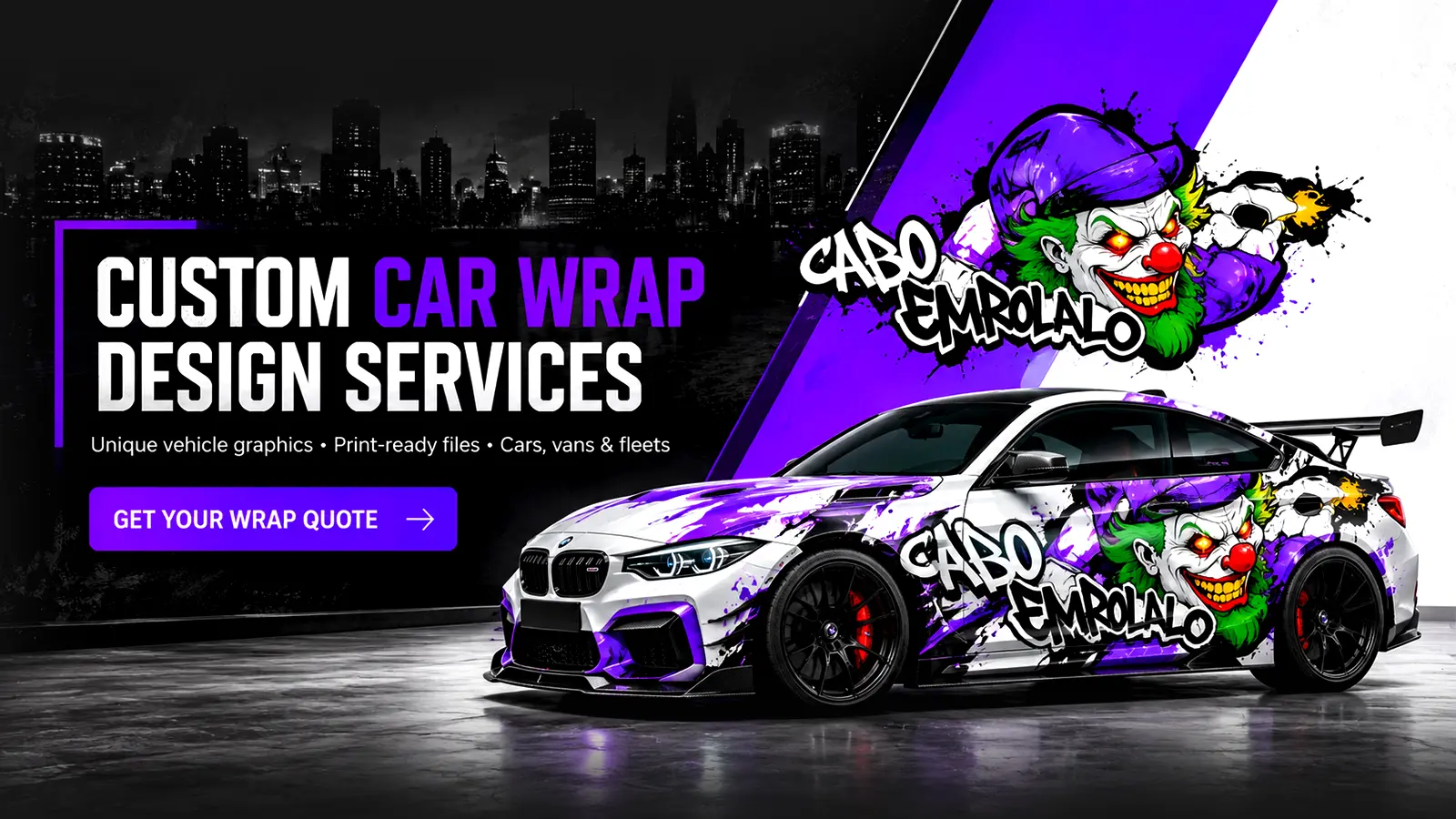
Custom car wrap design is the process of creating graphics laid out on an accurate template of a specific vehicle, then preparing those graphics as print-ready files for large-format vinyl printing. The designer plans every element around the vehicle’s real shape: door seams, handles, windows, wheel arches, bumpers, and compound curves.
It sits between branding and production. The designer takes your logo, colors, and message, turns them into a layout that reads well on a moving vehicle, and delivers files a wrap shop can print and install without guesswork. The printing and installation are separate steps, usually handled by a local wrap shop.
How Custom Vehicle Wrap Designs Make Brands Stand Out
A well-designed wrap does three jobs at once.
It advertises everywhere the vehicle goes. A service van crossing town every day is seen by commuters, neighbors, and local customers again and again. That repetition builds recognition in a way a one-time ad cannot.
It signals professionalism. A clean, branded truck tells a homeowner that a real business is pulling into their driveway. For contractors, movers, and home service companies, that trust matters before anyone says a word.
It makes the brand memorable. Unique vehicle wrap designs use color, shape, and layout to create a look people remember: a bold color block, a distinctive graphic, a clear phone number. A forgettable wrap blends into traffic. A distinctive one gets mentioned.
The key is that all of this happens in seconds. Most people see a vehicle for three to five seconds. A wrap design has to deliver the brand, the service, and the contact information inside that window.
Custom Car Wrap Design Services for Cars, Vans and Trucks
Different vehicles give a designer very different canvases.
Vehicle type | Typical design priorities |
Cars and sedans | Smaller panels, many curves; bold, simple graphics and minimal text |
SUVs and crossovers | More side area; logo and service on doors, contact on rear |
Cargo and sprinter vans | Large flat sides; ideal for services, phone number, website, and imagery |
Pickup trucks | Doors and bed sides; tailgate is prime space for contact details |
Box trucks | Huge flat panels; billboard-style layouts readable from far away |
Food trucks | Menu visibility, brand personality, serving window placement |
Trailers | Long flat sides; simple, high-contrast messaging |
A good custom vehicle wrap design service starts by asking which vehicle, not just which logo, because the layout must be built for that exact shape. A design for a high-roof cargo van will not simply fit a low-roof version of the same model.
Full Wrap vs. Partial Wrap: Which Design Is Right for You?
| Full wrap | Partial wrap |
Coverage | Entire painted surface | Selected areas, such as doors, sides, or rear |
Design freedom | Total color change and edge-to-edge graphics | Works with the vehicle’s base paint color |
Visual impact | Maximum | Strong if designed well |
Material and install cost | Highest | Lower |
Best for | Brand-heavy vehicles, food trucks, statement fleets | Budget-conscious businesses, service vans, white fleets |
When a partial wrap works best
Partial wraps are smart when the vehicle’s paint already suits the brand. A white van with a bold graphic sweeping across the rear half and a logo on the doors can look nearly as strong as a full wrap at a lower total cost. The designer’s job is to make the vinyl and the paint look like one intentional design, not a sticker on a car.
When a full wrap is worth it
Choose a full wrap when the brand color is the message, when the vehicle needs to look completely different from stock, or when the design depends on continuous graphics around the body.
How to Create Unique Vehicle Graphics for Your Brand
Unique doesn’t mean busy. Some of the most memorable wraps use very few elements. Here is how strong custom vehicle graphics usually come together.
Start from the brand, not the vehicle. Pull from your logo, colors, and personality. A plumbing company and a bakery should not look alike.
Pick one hero element. A bold color sweep, a large graphic, a product image, or the logo itself. One focal point beats five competing ones.
Use the vehicle’s shape. Lines that follow the body’s natural curves look intentional. Graphics that fight the shape look pasted on.
Plan for motion. Strong angles and directional shapes can make a vehicle look like it is moving forward, even when parked.
Keep text minimal. Business name, what you do, and how to reach you. Everything else is optional.
Design every side as its own view. People rarely see a vehicle from all angles at once. Each side should work alone.
Essential Elements of an Effective Commercial Vehicle Wrap
A commercial vehicle wrap design has a job: make the phone ring. These are the elements it needs.
Logo: large, clear, and on both sides and the rear
What you do: a short service line, such as “Residential Plumbing and Drain Repair”
Contact: phone number or website, big enough to read in traffic
Location or service area: useful for local businesses
Contrast: text color that stands out sharply from the background
Consistent branding: colors and fonts matching your website and signage
The readability rule
A common sign-industry rule of thumb is about 1 inch of letter height for every 10 feet of viewing distance for basic legibility. A phone number meant to be read from about 40 to 50 feet away should be roughly 4 to 5 inches tall, larger if it needs to grab attention rather than just be readable. Many wraps fail this test by squeezing contact details into small text.
The three-second test
Show the design to someone for three seconds, then ask: what is the business, what do they do, and how do you contact them? If they cannot answer all three, simplify.
How Vehicle Size and Body Shape Affect Wrap Design
Vehicles are not flat billboards. Body shape affects every layout decision.
Door seams and panel gaps cut through the design. Text or faces that cross them get split. A designer keeps critical elements, especially phone numbers, logos, and lettering, inside single panels.
Handles, mirrors, fuel doors, and lights interrupt the surface. Placing a letter or a face over a door handle is one of the most visible design mistakes.
Compound curves such as bumpers, fenders, and mirror housings stretch vinyl during installation. Fine detail and text in these areas can distort, so they are best used for color and background graphics.
Windows usually take perforated window film, which lets drivers see out but shows printed graphics from the outside. It reads lighter and less detailed than body vinyl, so windows should carry simple imagery, not essential text.
Recesses and deep channels, common on vans and box trucks, can be hard to wrap cleanly. Designers often keep detailed graphics off these areas.
This is why accurate vehicle templates, matched to the exact year, make, model, roof height, and wheelbase, are essential. A template built for the wrong variant can put a phone number right across a seam.
Logo Placement, Colors and Typography for Vehicle Graphics
Logo placement
Driver and passenger sides: usually on the doors or upper side panels, where eye level and parking angles favor visibility
Rear: logo plus contact details, since drivers behind you have time to read
Hood: optional; a logo here is mostly seen by people walking past a parked vehicle
Keep the logo the right way around on both sides. Text should always read left to right, so the passenger side is not simply a mirror image of the driver side.
Colors
High contrast reads at distance: dark text on light backgrounds or light text on dark ones. Avoid placing mid-tone text over busy images. Remember that wrap film is printed in CMYK, so very bright screen colors, especially neon greens and intense blues, may print duller. If brand color accuracy matters, ask the print shop for a color proof, or consider a printed color-change film for the base color.
Typography
Choose bold, simple fonts. Thin script, light weights, and condensed fonts blur at distance. Limit the design to one or two typefaces, and convert all text to outlines in the final files so fonts cannot be substituted at the print shop.
Preparing Print-Ready Artwork for Vehicle Wraps
This is where many designs fail, not visually, but technically. Print-ready car wrap fire vector artwork must meet large-format printing requirements. Here is how to prepare artwork for a vehicle wrap correctly.
Requirement | What it means |
Accurate vehicle template | Layout built on a scaled template of the exact vehicle |
Scale | Designs are often built at a reduced scale, such as 1:10, with resolution set to hold up at full size |
Vector logos and text | Logos and lettering in vector format (AI, EPS, PDF, or SVG) so they stay sharp at any size |
Raster resolution | Photos at enough resolution for full size, commonly about 100 to 150 dpi at final print size |
Bleed | Extra artwork beyond each panel edge, often several inches, so installers can trim and wrap edges cleanly |
Color mode | CMYK, with brand colors specified |
Fonts | Converted to outlines |
Layers | Organized, with the template on a separate non-printing layer |
File format | Usually a print-ready PDF, AI, or EPS, as the print shop requests |
Designers commonly work in Adobe Illustrator for the vector layout and Adobe Photoshop for photo-based imagery. The wrap shop then prints on cast vinyl wrap films from manufacturers such as 3M and Avery Dennison, which are made to stretch over curves.
Always confirm the exact file specifications with the print shop before final export. Bleed size, resolution, and format preferences vary from shop to shop.
If your logo exists only as a low-resolution image, it needs to be rebuilt as footbal ground vector design before it can be scaled across a vehicle. A vector conversion turns it into clean, scalable files suitable for large-format printing.
Common Car Wrap Design Mistakes to Avoid
These are the car wrap design mistakes that most often cost businesses calls, or cost a reprint.
Too much text. A full list of services turns a wrap into an unreadable brochure.
Small phone numbers. Contact details that cannot be read at distance defeat the purpose.
Text across seams and handles. Splits words and numbers.
Low-resolution images. Pixelation is obvious at full vehicle size.
Low contrast. Gray on silver or dark blue on black disappears in traffic.
Ignoring windows. Placing key text on perforated window film makes it faint.
Wrong template. Wrong roof height, wheelbase, or model year leads to misaligned graphics.
Mirrored passenger side. Logos and text read backwards.
No bleed. Installers have nothing to trim, leaving visible gaps at edges.
Screen colors only. Colors chosen on a bright monitor that print differently on vinyl.
Custom Fleet Wrap Design for Business Vehicles
Fleet wrap design services add a layer of planning: consistency across different vehicles.
A company might run two cargo vans, a pickup, and a box truck. Each has a different shape, yet all must look like one brand. Good fleet branding design achieves this with:
A design system, not one layout: shared colors, logo treatment, graphic style, and typography adapted to each vehicle
Consistent placement: logo in the same relative position on every vehicle
Scalable graphics that work on a compact car and a 26-foot box truck
Unit numbers for fleet tracking, placed the same way on each vehicle
Future-proofing: master files kept so new vehicles can be added later without redesigning
A fleet example
A plumbing company in Denver runs six high-roof cargo vans and two pickups. The designer builds one brand system: a bold blue sweep across the lower body, the logo on each door, “Plumbing, Drains and Water Heaters” on the upper side panels, and the phone number in large white type across the rear doors. The vans use the full layout. The pickups carry a shortened version that fits doors and the tailgate. When the company adds two new vans a year later, the master file is resized to the new template instead of starting over.
That is the real value of fleet wrap design services: every vehicle reinforces the same brand, and future vehicles are quicker to add.
What to Provide Before Starting a Custom Wrap Design
The fastest projects start with complete information. Before requesting a vehicle wrap design quote, gather:
Vehicle details: year, make, model, trim, roof height, and wheelbase
Photos of each side, front, and rear, taken straight on
Wrap type: full, partial, or lettering-focused
Logo in vector format, if available
Brand colors with exact references
Fonts or brand guidelines
Content: business name, services, phone number, website, social handles
Images you want included, in high resolution
References of wraps you like, and ones you don’t
Print shop specs, if you have already chosen a wrap shop
How to Choose a Professional Vehicle Wrap Designer
When you hire a car wrap designer, look for:
Wrap-specific experience. Designing for vehicles is different from designing a flyer.
Template-based layouts. Ask whether the design is built on an accurate template for your exact vehicle.
Mockups on your vehicle. You should see every side before approving.
Print-ready delivery. Files that meet the print shop’s bleed, resolution, and format requirements.
Revision process. A clear way to request changes before final files.
Brand understanding. Questions about your audience and goals, not just your logo.
File ownership. You should receive final editable files for future use and fleet expansion.
Custom Car Wrap Design vs. Wrap Printing and Installation
These are three separate jobs, and knowing the difference helps you budget and choose the right partners.
Step | What happens | Who usually does it |
Design | Layout, graphics, mockups, print-ready files | A wrap designer or design service |
Printing | Large-format printing on wrap vinyl, plus lamination | A print or wrap shop |
Installation | Cleaning, applying, trimming, and post-heating vinyl | Certified installers, usually at the wrap shop |
Some wrap shops offer all three. Many businesses choose to separate design from production, because it lets them own their design files, get competitive quotes from local installers, and keep a consistent look across vehicles in different cities.
At Infinity Digitizing, custom car wrap design services cover the design stage: setting up your vehicle template, creating the layout, adjusting graphics for panels, curves, and seams, placing your branding and contact details, and preparing final files for your wrap shop. Design projects are quoted individually based on vehicle type and scope, and you can review pricing or request a custom quote.
Turn Your Vehicle Into Your Best Advertisement
Your vehicles are already on the road every day. A custom car wrap design makes sure every mile works for your brand. Send your vehicle details, logo, and goals, and you will get a clear quote for a wrap design built on your exact vehicle, with print-ready files your wrap shop can produce.