Chenille is the most tactile patch you can put on a garment. That fuzzy, raised texture is also why it costs more than almost every other patch type, and why some designs simply cannot be made in it.
Chenille is the most tactile patch you can put on a garment. That fuzzy, raised texture is also why it costs more than almost every other patch type, and why some designs simply cannot be made in it.
Most pricing pages give you a per-piece number and stop there. This guide goes further. It breaks the chenille patch cost into the parts you are actually paying for, shows which design choices move the price, explains the technical reasons behind chenille’s design limits, and walks through a real budget so you can request a quote that matches what you get.
How Much Do Chenille Patches Cost in 2026?
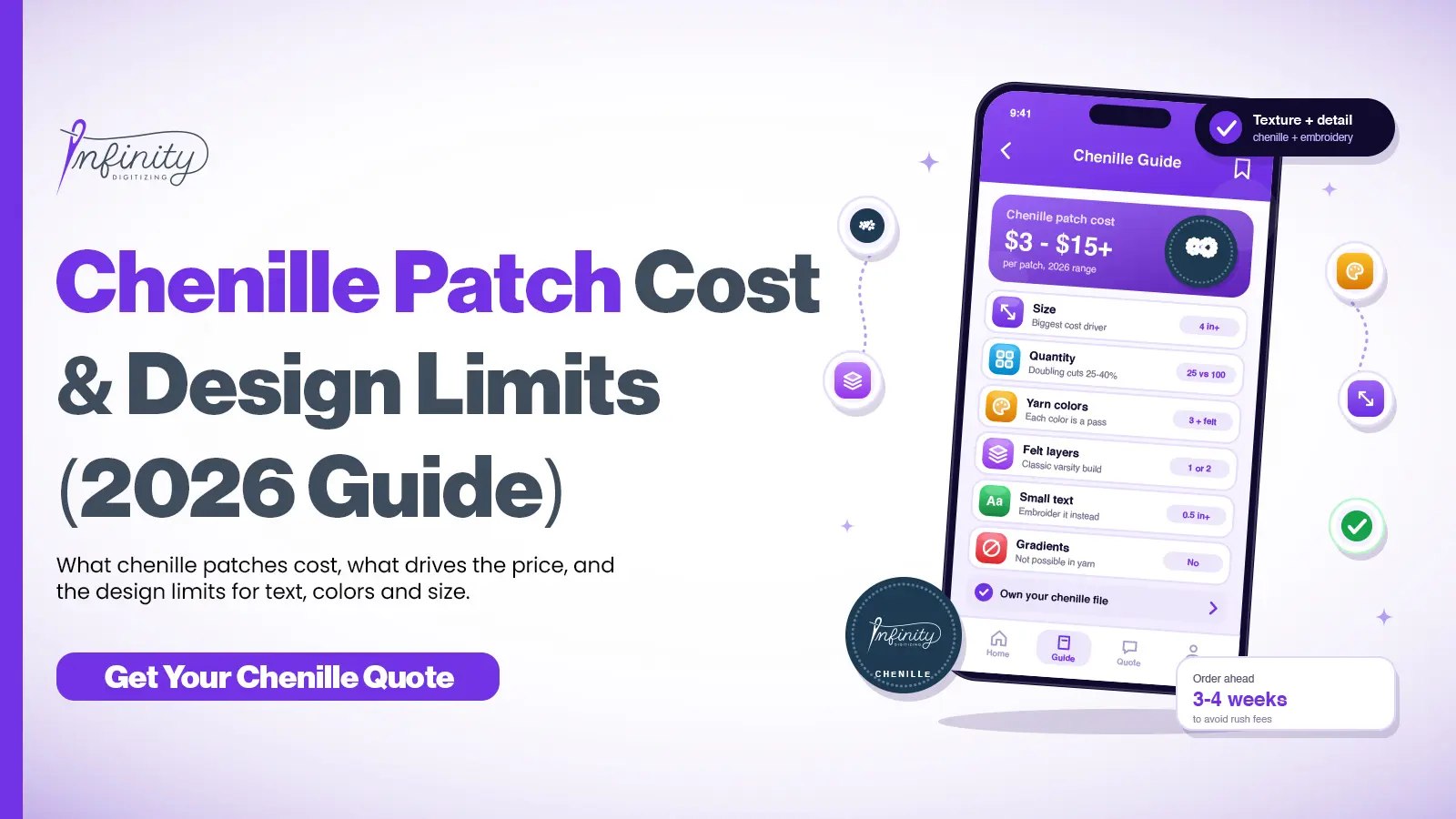
Across publicly listed pricing from US-facing patch makers in 2026, custom chenille patches commonly fall between about $3 and $15+ per patch. Very large runs of small patches can drop toward roughly $1.50 to $2 each, while small runs of large back-panel pieces can reach $20 or more per patch.
A rough picture of where most orders land:
Order type | Typical per-piece range |
Small patch (under 4 in), 25 pieces | About $6 to $10 |
Small patch (under 4 in), 100 pieces | About $3 to $5 |
Mid-size patch (6 to 8 in), 50 pieces | About $8 to $14 |
Large patch (about 12 in), 25 pieces | About $18 to $25 |
Large patch (about 12 in), 100 pieces | About $12 to $16 |
Single varsity letter (5 to 6 in) | Often quoted per letter |
These are market ranges, not a price list. The rest of this guide breaks down what moves your number.
What Are You Actually Paying For?
Chenille is priced higher because more goes into each piece. Every chenille patch combines several cost components:
Felt base layers. Most chenille patches sit on one or two layers of felt, cut to shape. More layers mean more material and more cutting.
Chenille yarn. Thick, looped yarn uses far more material per square inch than embroidery thread.
Machine time on a chenille machine. Chenille is sewn on specialized machines with a hooked needle that forms loops. These run slower than standard embroidery heads and are less common, which makes their time more expensive.
Embroidery detail. Fine text and outlines are usually stitched separately with regular embroidery, often on the same combination machine.
Digitizing. Someone has to build the chenille file, planning the loop areas, chain-stitch outlines, and sewing order.
Finishing and setup. Cutting, edges, backing, mockups, and proofs.
Some makers advertise “no setup or digitizing fees.” That usually means those costs are built into the per-piece price, not that the work does not happen. It matters later, as you will see in the section on reorders.
What Affects Chenille Patch Cost?
Size
Size is the biggest single driver, covered in detail below. Most makers measure size as the average of width and height, so a 10 by 6 inch patch is priced as an 8 inch patch.
Quantity
Chenille has real fixed costs per design: setup, digitizing, proofing, and changeovers. Spread across 25 pieces, each patch carries a large share; across 500, a small one. Doubling an order often lowers the per-piece price by 25 to 40 percent at the small end.
Number of yarn colors
Each chenille color is a separate pass on the machine with a different yarn. Most makers cap chenille at about three yarn colors plus the felt base, and each added color raises cost and production time.
Felt layers
A single felt base is the simplest build. A two-layer patch, such as a white felt letter on top of a navy felt outline, is the classic varsity look but adds material, an extra cutting step, and more alignment work.
Embroidery add-ons
Small text, outlines, and details stitched in regular embroidery add machine time and color changes on top of the chenille.
Backing
Sew-on is the base option. Iron-on and hook-and-loop backings typically add a small amount per piece.
Turnaround
Rush orders typically cost extra because they move ahead of other work on a limited number of chenille machines.
Chenille Patch Design Limitations: The Rules Behind Them
Knowing the limits before you design saves revision rounds and keeps the price down. Here are the chenille patch design limitations most makers work within, and why they exist.
Design element | Common working limit | Why |
Smallest chenille text | About 12 mm (roughly 0.5 in) tall | Loops are thick and blur small shapes |
Smallest line in chenille | About 3 to 4 mm wide | Narrower lines cannot hold loops |
Standalone chenille letters | About 2 in minimum, 3 in+ recommended | Small letters lose shape and edges |
Yarn colors | About 3 plus the felt base | Each color is a separate machine pass |
Gradients and shading | Not possible in chenille | Yarn is a solid color block |
Fine detail and small text | Done in embroidery instead | Embroidery thread is far thinner |
Embroidered text | Possible down to about 4 mm | Standard satin stitch handles small sizes |
Why the limits exist
Chenille is built from two stitch types. Moss (loop) stitch creates the fluffy, terry-like texture by pulling yarn up into loops. Chain stitch sews a flat, braided line, often used for outlines and decorative fills. Both use thick yarn. A loop of chenille yarn is several millimeters across, so any shape smaller than a few loops simply has no room to form.
Can Chenille Patches Have Small Text?
Yes, but not in chenille itself. Small text on a chenille patch is almost always stitched in regular embroidery on top of or beside the chenille.
A typical varsity patch has a bold chenille letter or mascot with the year or team name embroidered below it. Chenille carries the texture; embroidery carries the detail.
If text must be in chenille, keep it at about 0.5 inch tall or more, choose a bold, simple font, and avoid thin serifs. For anything smaller, plan it as embroidery from the start. Combining the two techniques well is a digitizing decision, and it is where chenille digitizing earns its value: deciding which elements loop, which chain, and which stitch as flat embroidery.
How Many Colors Can Chenille Patches Have?
Most chenille patches use up to about three yarn colors plus the felt base, and many classic designs use just one or two. Felt layers add more color without adding yarn passes, so a design with two felt colors and two yarn colors can look like four colors.
If your logo has six colors, you have three options:
Reduce the palette to the two or three colors that define the brand.
Move some colors to felt, such as a background panel or outline layer.
Put small colored details in embroidery, which can use more thread colors.
Chenille yarn also comes in a narrower color range than embroidery thread, so brand colors are matched to the closest yarn. If exact color matters, ask for a yarn chart or physical sample.
Chenille Patch Size Limits
Chenille works best at larger sizes, which is the opposite of most patch types.
Size range | What works well |
2 to 3 in | Simple icons, single letters; detail is very limited |
4 to 6 in | Varsity letters, sleeve patches, chest logos |
8 to 12 in | Mascots, team crests, statement chest pieces |
12 in and up | Jacket back panels, large brand logos |
Many makers produce chenille up to about 14 inches through standard pricing and larger pieces, up to roughly 25 inches, by custom quote. The bigger the patch, the more room chenille has to show texture, which is why back panels are some of the most popular chenille orders.
On the small end, a 2 inch chenille patch is possible, but at that size the design must be extremely simple. If your design needs detail at under 3 inches, an embroidered patch is usually the better choice.
How Patch Size Affects Pricing
Because chenille is priced largely by material and machine time, cost rises faster than size. Doubling the width and height of a patch roughly quadruples its area, so a jump from 4 inches to 8 inches can raise the per-piece price by two to three times, even at the same quantity.
Before sizing up for impact, check whether a slightly smaller version still reads well at a distance. Dropping a back panel from 12 to 10 inches cuts its area by about 30 percent.
Chenille vs Embroidered Patches Cost
Here is how chenille vs embroidered patches cost compares.
| Chenille patches | Embroidered patches |
Typical per-piece range | About $3 to $15+ | About $1 to $8 |
Look and feel | Raised, fuzzy, textured | Flat, smooth, detailed |
Small text | Not in chenille; needs embroidery | Handles small text well |
Color count | About 3 yarn colors + felt | Many thread colors |
Best sizes | 4 in and larger | 1 to 6 in |
Best uses | Varsity jackets, back panels, retro brand pieces | Uniforms, caps, detailed logos |
Production | Specialized chenille machines | Standard embroidery machines |
Chenille costs more because it uses more material, slower specialized machines, and extra felt and cutting steps. Embroidered patches win on detail and price, especially at small sizes. Many brands use both: chenille for the statement piece and embroidered patches for sleeves, caps, and small details.
Iron-On vs Sew-On for Chenille
Backing affects both cost and durability.
Sew-on is the traditional choice for varsity and letterman jackets. It costs the least and holds up best on heavy wool and leather, since many of those materials do not take heat well.
Iron-on (heat-applied) backing is popular because it is easy to apply. It works well on smaller chenille patches on cotton and canvas. On large chenille pieces, heat backing alone may lift at the edges over time, so many shops press the patch on and then add a few stitches around the edge for security.
Check the jacket fabric before choosing. Wool varsity bodies and leather sleeves generally should not be pressed at high heat, so sew-on is the safer route there.
A Sample Budget: Team Varsity Order
Here is how a typical budget comes together. A high school booster club in Ohio needs patches for 40 letterman jackets: a 6 inch chenille letter with a two-layer felt build, plus a 3 inch embroidered year patch for each sleeve.
Item | Assumption | Estimated range |
40 chenille letters, 6 in, 2 felt layers, 2 yarn colors | Mid-size, small run | About $8 to $14 each, $320 to $560 |
40 embroidered year patches, 3 in | Small embroidered run | About $3 to $5 each, $120 to $200 |
Sew-on backing | Base option | Included |
Standard turnaround | No rush | Included |
Estimated total |
| About $440 to $760 |
These are planning estimates only. The key point is how the budget splits: the chenille letter is the premium piece, while the small text lives on a cheaper embroidered patch. If the booster club had tried to put the year in chenille on the letter itself, it would have needed a larger letter or failed the minimum text size.
How to Reduce Chenille Patch Costs
You can lower custom chenille patches cost without losing the look:
Order more at once. Combine seasons, teams, or product lines into one run to climb the quantity break.
Trim the size slightly. A small reduction can noticeably lower material use.
Limit yarn colors to two or three.
Use felt for color instead of extra yarn passes.
Move small text to embroidery, either on the patch or on a separate small patch.
Choose sew-on where the garment allows it.
Avoid rush fees by ordering three to four weeks before you need the patches, especially in the late-summer and early-fall varsity season.
The Hidden Cost Most Buyers Miss: Owning Your File
Many chenille makers include digitizing in the per-piece price and keep the production file. That works fine as long as you reorder from the same maker. If you switch suppliers, need the design on a different machine, or want a matched embroidered version, you may have to pay to recreate the file from scratch, and the new version may not look exactly the same.
Owning a professionally built chenille file lets any compatible chenille shop produce the same patch and keeps reorders consistent.
This is where Infinity Digitizing fits. Infinity does not manufacture patches; it builds the production files that patch makers and embroidery shops sew from. Chenille files are planned for loop areas, chain-stitch outlines, felt placement, and embroidery details, then delivered in the machine format your producer needs, such as DST. Chenille digitizing is quoted by design size and complexity, and you see the price before work begins.
Before You Request a Custom Chenille Patches Quote
A complete request gets an accurate quote on the first try. Include:
Artwork, ideally vector. If you only have a low-resolution image, a vector redraw makes every later step cleaner.
Finished size in inches, width and height
Quantity, plus any likely reorders
Yarn and felt colors, with brand color references
Felt layers, one or two
Backing: sew-on, iron-on, or hook-and-loop
Deadline, so you know whether rush pricing applies
Whether you need the production file for future use
Always ask for a proof, and for first-time orders, a physical sample.
Get Your Chenille File Built Right the First Time
A great chenille patch starts with a file that respects chenille’s limits: bold loop areas, clean chain outlines, and fine details moved to embroidery. Infinity Digitizing builds chenille and patch production files for brands, varsity suppliers, and embroidery shops, ready for any compatible chenille machine.
Send your artwork, size, colors, and garment, and you will get a clear quote for your chenille file before any work starts.